View crop
View crop Data sheet EcoPortVetiveria zizanioides
 |
|
| Notes |
|---|
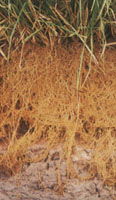
| BRIEF DESCRIPTION A densely tufted, wiry, erect, glabrous grass up to 0.5-1.5 m tall. USES The roots yield an essential oil used as a fixative for more volatile ingredients in soaps, cosmetics and perfumes. The roots are also used for basketry, mats, fans, screens, awnings, sachet bags, and other woven handicrafts. The grass is grown as a hedge plant, it is used for contour plantings, as erosion control on borders and roads, for soil recalmation for pollution and flood control and biomass production. KILLING TEMP -15°C to -20°C. GROWING PERIOD Perennial. The roots may be ready for harvest after 12-24 months. COMMON NAMES Vetiver, Khas-khas grass, Lacate violeta, Khuskhus. FURTHER INF Scientific synonym: Andropogon murica. Vetiver is native of India and Sri Lanka. In India, it is normally grown at altitudes between sea level and 600 m, while in Bolivia, it is grown successfully up to 2500 m. In Africa, it can be found from sea level to 1100 m. It requires a hot and humid climate. In Indonesia, it is for the production of roots, grown on loose sandy ground or young vulcanic ashes from which the roots can easily be pulled. Vetiver comes in two types, one of them (a domesticated type from South India) is suitable for erosion control, while the other (a wild type from North India) may spread and produce a weed problem for farmers. Photosynthesis pathway C4. The yield is 1-5 t dried roots per ha per year, and at an oil content of 0.7-2.5%, this produces up to 40-100 kg oil per ha. It is highly tolerant to Ag, Cd, Mn, Al and other heavfy metals and toxic materials. Mentioned as a useful agroforestry species. | Sources |
| Grassland Index Skerman P 1990 pp 747-748 [RAIN, DRA, TEXT, PH, USE] Duke J 1979 pp 96 [PH, RAIN, TEMP] Purseglove J 1972 pp 297-299 [USE, DRA, TEMP, TEXT] Sims D (pers. comm.) Ruskin F 1993 pp 71 Nair P 1980 pp 316 [FER, DRA, USE, TEXT] Tantum T 1995 pp 12-13 [PH, RAIN, USE] Grimshaw R 1996 (pers. comm.) |