View crop
View crop Data sheet EcoPortProsopis tamarugo
 |
|
| Notes |
|---|
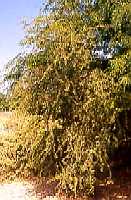
| BRIEF DESCRIPTION A medium-sized, spiny deciduous tree reaching 8-18 m in height and up to 80 cm in trunk diameter. The crown is thin and open. USES Wood used for firewood, charcoal, furniture, and construction. Sheep and goats eat fallen pods and leaves and browse young shoots. Pods can be leached and used for human food. Mentioned as a possible agroforestry species. GROWING PERIOD Perennial. May reach 10 m in height in 15 years even under harsh conditions. Withstands droughts of 10-12 months. COMMON NAMES Tamarugo. FURTHER INF Scientific synonym: P. chilensis. Tamarugo occurs naturally within the latitudinal range 18-21°S, at elevations from 1000 to 2500 m. The tree can be found on the arid salt flats of northern Chile, sometimes with salt incrustation of 10-60 cm thickness at the surface and the water table at a depth of 20 m. Often these areas are without rain for years, however, at night there is a high relative humidity and the trees absorb moisture through the leaves. Tamarugo is drought hardy and regenerates rapidly. The seedlings need to be watered during the first year. Under less harsh conditions, the plant might spread uncontrollably and become a serious weed. Photosynthesis pathway C3. Annual wood production potential is 2-4 m3/ha. Each tamarugo tree yields up to 160 kg of pods, leaves, and small twigs, which layer the soil beneath the tree and provide yearround feed. | Sources |
| Little E 1983 pp 243-246 [SAL, LIMIT, USE, RAIN, TEMP, KTMP, TEXT] Webb D 1984 pp 236 [RAIN, TEMP, TEXT, PH, DRA, SAL, LIG, USE] Habit M 1986 pp 521 Aronson J 1989 pp 64 National AS 1975 pp 128 National RC 1980 pp 156 National RC 1979 pp 158 INSPIRE species 153 [RAIN, TEMP, TEXT, PH, DRA, SAL, LIG, USE] Hensleight T 1988 pp 384 [TEMP, RAIN, SAL, USE] |