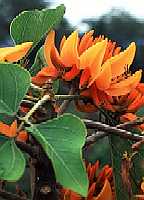
| DESCRIPTION: An evergreen or deciduous tree reaching up to 35 m in height and 2 m in diameter. The tree shifts from evergreen to deciduous along a rainfall gradient from the humid lowlands to the subhumid mountains. The leafless period is quite short and is possibly caused by flowering rather than drought. A visible reduction of foliage during flowering also occurs under humid conditions. The crown is moderately spreading and the bole tends to be branchless below 10-20 m. Bark is greyish brown or grey, with thorn-like protuberances. Leaves are alternate, trifoliolate. Flowers caducous, orange or reddish, produced in racemes. USE: Leaves as used as fodder, wood as fuel. It is planted as a shade tree in cacao and coffee plantations, it conserves soil and contributes to high and sustainable yields. For alley cropping, it should be planted in dense hedgerows (1-2 m between trees), with wide alleys (6-8 m) between tree rows. High and sustainable bean yield in the alley-cropping system has been observed. In Costa Rica, E. poeppigiana alley cropping has sustained 2 maize crops per year over 8 years without fertilization. It nodulates abundantly with nitrogen-fixing bacteria of the genus Bradyrhizobium and leaves are used as green manure. GROWING PERIOD: Perennial. COMMON NAMES: coral tree. FURTHER INF: It is native to humid and subhumid tropical lowlands, such as the riverine and upland forests of the Amazon and Orinoco Basins, but cultivated and naturalized trees are now found at elevations up to 2000 m. Tolerates low soil fertility and relatively high acidity (down to pH 4.3). However, tolerance varies by genotype. |