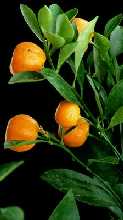
| BRIEF DESCRIPTION A small straight, columnar, slightly spiny evergreen shrub or treelet reaching 2-7.5 m in height, with a slender stem and upright branches. It has a long taproot, elliptic to obovate leaves, 3-8 x 1-4 cm, and the fruit is a subglobose to globose berry, up to 4.5 cm in diameter with a greenish-yellow to orange-red colour. USES The acid fruit juice is processed into bottled concentrate and juice. It is also used as a stain remover, body deodorant, skin bleach, hair shampoo and as a skin treatment. The fruit is used for marmelade and chutneys, preserved whole in sugar syrup, and used as flavouring in seafood and meat dishes. The flowers are a source of honey. It may serve as a rootstock for lemons and the oval kumquat. It is planted as an ornamental. GROWING PERIOD Perennial. Cloned trees come into bearing 3 years after planting, seedlings after 5-6 years. Fruit mature about 5 months from flowering. COMMON NAMES Calamondin, China orange, Golden lime, Jeruk peres, Jeruk kasturi, Jeruk potong, Limau kesturi, Limau chuit, Kalamondin, Kalamansi, Limonsito, Sommapit, Somchit, Manao-wan, Tac hanh. FURTHER INF Scientific synonym: x C. mitis, Citrus microcarpa, C. mitis. Calamondin almost certainly originated in China as a natural hybrid between a sour, loose-skinned mandarin, probably Citrus reticulata var. austera and a kumquat, perhaps Fortunella margarita. It thrives in areas with an evenly distributed rainfall, or irrigation and is usually grown in the lowlands. It is not resistant to strong winds. At 6 years the tree may yield 10 kg fruit and at 10 years it may yield 50 kg. An orchard with 625 trees/ha, with an average yield of about 30 kg/tree, will yield about 19 t/ha. (TEMP estimated by the compiler). |