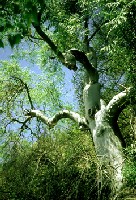
(05.06.03) E363339
DESCRIPTION: It is a shrub-like deciduous or evergreen tree, often with a dense crown, growing up to 10-15 m of height. By the end of a long dry season the trees may have lost their leaves. USE: All parts of the tree except the wood are edible, providing a highly nutritious food for both humans and animals. Leaves, pods and even flowers are consumed as a delicious vegetable and prevent malnutrition of mothers and children, if consumed by pregnant and breast-feeding women. Attracting attention in recent decades is the use of the dried, crushed seeds as a coagulant similar to the chemical alum. Even very muddy water can be cleared when crushed seeds are added. Solid matter and some bacteria will coagulate and then sink to the bottom of a container. The cleaned water can then be poured off and boiled. GROWING PERIOD: Perennial. COMMON NAMES: African moringa tree, Cabbage tree. FURTHER INF: Grows in mid- and lowland bushland. Farmers in Bedessa do not grow it on-farm because there are still enough wild species in the bush surrounding the farms. Light frosts will do it no harm. Freezes, though, may cause it to die back to ground level, where new sprouts may be produced. It usually keeps its lush green foliage and continues to grow even during exceptionally long dry seasons. It is more drought tolerant than Moringa oleifera. It is native only to southern Ethiopia northern Kenya and Eastern Somalia. Though it does grow in many other parts of the old- and new-world tropics, it is not as widely known as its close relative, Moringa oleifera. In Ethiopia, it is found in the Eastern part of the Rift valley especially in Konso, the Omo areas and West Gamu Gofa. |
Hartmann I., 2003, And the Water Became Sweet, The Potential of Moringa Stenopetala Seeds for Water Clarification in Ethiopia (poster)
ECHO, 2003, Moringa, 17430 Durrance Rd., N. Ft. Myers, FL 33917-2239 USA. website: www.echonet.org |