View crop
View crop Data sheet EcoPortSorghum bicolor var. sweet
 |
|
| Notes |
|---|
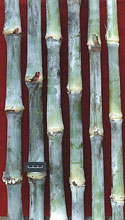
| DESCRIPTION: A single-stemmed grass and cereal crop reaching a height of 1-5 m; it is usually taller than grain sorghum. It has a strong root system and a layer of heavy disilicate covers the epidermis of the root. As the root grows to maturity it forms an entire silicon column; which provides it with enough mechanical density during a drought period to prevent the root system from collapsing. It has fibrous, spreading roots and consists of a primary, secondary and supporting roots. The primary root is developed from the seed embryo. It is the only embryo root produced by the seed during germination. Before the production of secondary roots, the primary root is the main organ by which the plant absorbs nutrients and moisture from the soil. Prop roots may grow from culm nodes. There is a bud at each node from which a tiller may grow. The only temporary root in sorghum is the single radicle of the germinating seedling. Mature roots of sorghum are all adventitious. Those permanent roots have numerous branched lateral roots interlacing the soil in all directions. The system may extend to at least 1.5 m away from the plant, and is most abundant in the top 90 cm, although it may extend to twice that depth. One of the important factors affecting water use and drought endurance must be the effectiveness of the root system. While the primary roots of maize and sorghum are equally extensive, sorghum possesses twice as many secondary roots as maize at any one stage of growth. After the plant produces 3-4 leaves, secondary roots grow out from the base of the stalk node near the soil surface. The stalk has about 10-20 clearly protruding nodes and a leaf is produced from every node. Leaves (30-135 cm long and 6-13 cm wide) are opposite-decussate and consist of the sheath, blade and tongue or ligule. The sheath is very long and adheres closely to a major part of the internode. The blade is broad, strap-like, dentate and the surface is smooth and covered with a waxy powder which plays a role in reducing evaporation. In dry conditions, the leaf blade will roll up into a tube, reducing the exposed area and thus cutting down the loss of moisture. Flowers are grouped in an apical panicle formed by several reddish spikelets. The grain is an oblong caryopsis; which consists of the seed coat, testa, endosperm and embryo. The shapes and colours of seeds are very varied and are covered by glumes and there are round, flat-round, oval, ellipse shapes etc. The colours include white, light yellow, pink, brown, red-brown, dark brown etc. In general, the seed of sweet sorghum is smaller than that of grain sorghum; the thousand-seed weight is about 21g varying between 16-28g. (25,000 to 61,740/kg for sweet and grain sorghum; 120,000 to 159,000/kg for grass sorghum). USES: The versatility of sweet sorghum resulted in Prof. Li Dajue (of the Chinese Academy of Sciences) and Peter Griffee (FAO) coining the name the "Four F's Crop" for sweet sorghum in 1997 at the first International Sweet Sorghum Conference. The "Four Fs" represent the four potential outputs from sweet sorghum, namely: Food, Fuel, Fodder, & Fibre. In Asia, R&D has concentrated on maximizing all four outputs to produce the 'multi-purpose' varieties, whilst in Europe, the potential use of sweet sorghum as a sugar producer for fuel ethanol production has driven the current direction of R&D towards liquid bio-fuel production. In southern Africa, the potential for using sweet sorghum for energy and crystalline sugar production is being explored. A disadvantage is that the stems have to be processed within a matter of hours after harvest. However, new technology is emerging for in-field juice extraction and storage to extend the factory processing period. The grain can be ground into flour, some cultivars can be used as popcorn and the grain can be manufactured into beer. Stems are used for thatching, fencing, brushes, and basketry. A dye can be extracted. Grain and straw can be fed to livestock and embryos yield an oil used in cooking and salad oils. The inflorescence has astringent, haemostatic and antidiarrhoeic properties and administration is as infusion, tincture and medicinal wine. GROWING PERIOD: Annual or short-term perennial grass. Most sorghum plants take 90-120 days to mature, the boot stage is reached in 50-60 days, flowering in 60-70 days and full grain maturity in 90-120 days. COMMON NAMES: Sorghum, Sorgho, Sorgo, Great millet, Milo, Jowar, Cholam, Guinea corn, Durra, Mtama, Jowal, Jolar, Cholam, Koaliang. FURTHER INF.: Lowland tropical sorghums are adapted to warm days and night temperatures above 22°C throughout the growing season. The poisonous glucocide 'dhurrin' in sorghum is present from germination, increasing to a maximum and then disappearing as the grain develops, so that in the later stages the plants is safe as fodder. New long day varieties exist. The photosynthesis pathway C4III. The species is probably indigenous to North-East Africa, north of latitude 10°N and east of longitude 25°E. Sorghum is grown between 40°N and S. Sweet sorghum can be found at elevations between sea level and 1500 m, most East African sorghum is grown between the altitudes of 900-1500 m, and cool-tolerant varieties are grown between 1600 and 2500 m. The nutrient removal for 1 ton of grain is about 50 kg N, 9 kg P, and 45 kg K, calculated from the above-ground plant mass. Grain yields of up to 4 t/ha can be obtained, but in the driest areas, the yield usually varies between 0.3-1.2 t/ha, and the global average is about 1.3 t/ha. Like the common grain sorghum, sweet sorghum can produce grain yields of 1500-7500 kg/ha. But the essence of sweet sorghum is not from its seed, but from its stalk; which contains sugar. In general, the stalk yield is 45000-75000 kg/ha. The sugar content in the juice of sweet sorghum varies in different varieties. It's Brix ranges generally from between 15-23%. Genetic resources: There is a wide varaition in seed type from Beijing Botanical Garden's sweet sorghum germplasm collection. ICRISAT is involved in diversification of sorghum breeding populations, and ultimately cultivars available to farmers, through the incorporation of traits and genetic materials that have not previously been used in crop improvement. For example, new random-mating populations have been produced using diverse germplasm selected for resistance to head and stem pests, earliness with high grain and biomass yield, tillering ability, large grain and resistance to grain molds. ICRISAT initiated a program for the identification and development of sweet-stalked and high-biomass sorghum hybrid parents and varieties in 2002. Promising lines such as ICSB 631 and ICSB 264 among the seed parents; and Seredo, ICSR 93034, S 35, ICSV 700, ICSV 93046, E 36-1, NTJ 2 and Entry 64 DTN among the varieties/male parents were identified for their high stalk sugar content. The sugar percentage in these seed parents and varieties ranged from 16.8% to 21.6%. Four of these lines, S 35, ICSV 700, ICSR 93034 and Entry 64 DTN are being evaluated in the All India Coordinated Sorghum Improvement Program (AICSIP). A Special/Sweet Sorghum Hybrid (SSH) 104 developed from ICSA 38, an ICRISAT-bred male-sterile (seed) parent and SSV 84, a male parent bred in India is being recommended for release for commercial cultivation. The national sorghum program, through extensive testing in AICSIP, released a sweet-stalk sorghum variety SSV 84 in 1992/93 for general cultivation. The wide variability available in germplasm and hybrid parents for the traits related to ethanol production such as percentage of sugar, sucrose and Brix (a measure for sugar content in liquids) and high stalk yield offers bright scope for the development of high stalk yielding sugar-rich varieties and hybrids. The EMBRAPA National Centre of Maize and Sorghum Research in Brazil has also developed new sweet sorghum varieties and work closely with ICRISAT. |
Sources |
| Sweet sorghum manual (FAO) ICRISAT sweet sorghum development Sims D (pers. comm.) Doggett H 1988 pp 1-498 [TEMP, PHO, LIG, PH, SAL, DRA, TEXT, FER] Rehm S 1991 pp 24-29 [TEMP, RAIN, PHO, PH, SAL, DRA, DEP] Kassam A 1976 pp 9 Sys c 1984 pp 70 Landon J 1984 pp 280 285 288 290 304 [TEXT, DRA, DEP, PH, FER] Maas E 1990 pp 271 Doorenbos J & Kassam A 1979 pp 135 Sys C 1990 pp 12 Bunting E 1991 pp 22 Roecklein J 1987 pp 41 [USE] Eswaran H 1986 Kung P 1970 pp 206 Skerman P 1990 pp 677-685 [RAIN, DRA, TEXT, DEP, PH, PHO, TEMP] Bogdan A 1977 pp 269 Edwards S up pp 120 Purseglove J 1972 pp 262-287 [DRA, KTMP, TEMP, TEXT, PH, PHO] Nair P 1980 pp 73-78 [RAIN, TEMP, TEXT, FER, DRA, USE] Van Waveren E 1993 pp 33 Onwueme I 1991 pp 176-189 [KTMP, TEMP, RAIN, PH, SAL, FER] |