View crop
View crop Data sheet EcoPortPersea americana ssp. mexican
 |
|
| Notes |
|---|
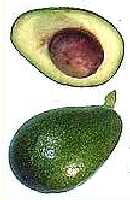
| BRIEF DESCRIPTION A small, spreading, evergreen or nearly deciduous tree reaching a height of 20 m although grafted trees usually are 8-10 m tall. Trees in the Mexican group lose nearly all there leaves in winter. It has a low branched trunk and an irregular, densely foliated crown. Fruits are 7-20 cm lang and 7-10 cm in diameter. They may be round, oblong, pear shaped or bottle necked, green or may be tinged with purple. USES The pulp is used as a fresh salad fruit. The pulp can be frozen, used in guacamole and various sauces, and as a flavor in ice creams. The pulp contain 3-30% of an edible oil similar to olive oil. The unripe fruit is poisonous and the ground-up seed mixed with cheese is used as rat and mouse killer. Mentioned as a useful agroforestry species. KILLING T The Mexican type may tolerate -6°C, but the trees will not tolerate frost during the flowering period. GROWING PERIOD Perennial. Trees from seedlings begins to bear after 4-5 years and grafted trees begin to fruit after the 3rd year. Fruits mature from 270-540 days after flowering, depending on cultivar and climate. Flowers between May and August in Mexico. COMMON NAMES Avocado, Mexican avocado, Avocado pear, Avocat, Advogado, Avocato, Abacate, Ahuacate, Avocatier, Avoca, Aguacate, Aguacate de mico, Alligator pear, Cura, Ahuacatl, Pahua, Palta, Veranero, Huita palta, Palto, Zihene, Cupanda, Kirtum, On, Tzatzan, Ahuacaquahuitl-tree. FURTHER INF Scientific synonyms: P. persea, P. gratissima, P. drymifolia, Laurus persea. The Mexican group is probably indigenous to high-elevation areas in Mexico and there trees of this group can be found at elevations between 2400-2800 m. They can be grown between 42°N and S. Avocado prefer medium humidity. The wood is spongy and breaks easily in strong winds. It can reach a height of up to 14 m. Photosynthesis pathway C 3. The optimum yields are for Fuerte Hybrid 7-11 t/ha, and for Hass Hybrid 8-14 t/ha. | Sources |
| SOURCES (P. americana Mill.) Sims D (pers. comm.) Rhem S 1991 pp 192-193 [KTMP, DEP, DRA, TEXT, PH, SAL] Samson J 1986 pp 235-255 [TEMP, RAIN, LIG, PHO, DRA, TEXT, PH] Roecklein J 1987 pp 198 [USE, TEXT, DRA, SAL, TEMP] Eswaran H 1986 pp 6 12 81 Hartmann T 1981 pp 610-611 [KTMP, TEXT, DRA, FER] Rice R 1990 pp 60-65 [KTMP, DRA, SAL, FER] Duke J 1975 pp 23 [PH, RAIN, TEMP] Sauls J 1976 Hackett C 1982 pp 122 [FER, PHO, DEP, PH, TEXT, TEMP] Popenoe W 1974 pp 23 Nair P 1984 pp 19 [RAIN, TEMP, TEXT, DEP, DRA, USE] Van Waveren E 1993 pp 53 FAO For. Paper 67 pp 161 Hensleigh T 1988 pp 249-253 [DEP, TEXT, DRA, PH, SAL, TEMP, KTMP, RAIN, LIMITS] Martin F 1984 pp 247-249 [TEMP, KTMP, RAIN, DRA, TEXT, USE] |